Bookshelf
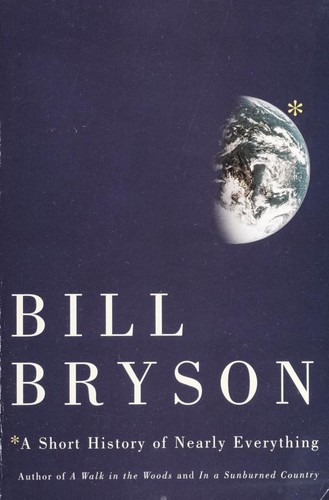
A short history of nearly everything
by Bill Bryson
- science
- popular works
- ciencia
- obras populares
- obras de divulgacio n.
- natuurwetenschappen
Keep track of it on your own bookshelf.
Log in to add itAbout this book
A wonder-filled quest to understand everything that has happened in the history of the Earth, from the Big Bang theory to the rise of civilization and beyond—revised to reflect the last two decades of scientific advancement
“Brims with strange and amazing facts . . . destined to become a modern classic of science writing.”—The New York Times
How did we get from being nothing at all to where we are today? How did the age of the dinosaurs eventually give way to the age of the iPhone? In this completely revised update to the international phenomenon A Short History of Nearly Everything, Bill Bryson returns to answer these questions and many more.
Bryson brings a groundbreaking account of life itself to a new generation of readers, as he takes subjects often passed off as boring and incomprehensible and renders them accessible, fascinating, and outright amusing to anyone who’s ever wondered about the world around them. Introducing readers to a diverse cast of the world’s most impressive archaeologists, paleontologists, physicists, astronomers, anthropologists, and mathematicians—from their offices and laboratories to dig sites and field camps—Bryson embarks on a journey to discover answers to the biggest questions about the universe and ourselves.
A Short History of Nearly Everything is a profoundly enlightening, surprisingly humorous, and charmingly clever adventure into the realm of human knowledge, as only Bryson can render it. His revamped Short History is a thrilling journey through time and space, and his writing will make readers both new and old see the world in a whole new way.
Quotes
From WikiquoteIt is a slightly arresting notion that if you were to pick yourself apart with tweezers, one atom at a time, you would produce a mound of fine atomic dust, none of which had ever been alive but all of which had once been you.
All that can really be said is that at some indeterminate point in the very distant past, for reasons unknown, there came the moment known to science as t = 0. We were on our way.
In France, a chemist named Pilatre de Rozier tested the flammability of hydrogen by gulping a mouthful and blowing across an open flame, proving at a stroke that hydrogen is indeed explosively combustible and that eyebrows are not necessarily a permanent feature of one's face.
It is natural human impulse to think of evolution as a long chain of improvements, of a never-ending advance towards largeness and complexity — in a word, towards us. We flatter ourselves. Most of the real diversity in evolution has been small-scale. We large things are just flukes — an interesting side branch.
More by Bill Bryson
All books-
The Best American Travel Writing 2000Bill BrysonThe Best American Travel Writing 2000Bill Bryson

-
Notes from a Small IslandBill BrysonNotes from a Small IslandBill Bryson

-
The Life and Times of the Thunderbolt KidBill BrysonThe Life and Times of the Thunderbolt KidBill Bryson

-
A Walk in the WoodsBill BrysonA Walk in the WoodsBill Bryson

-
The Mother TongueBill BrysonThe Mother TongueBill Bryson

-
The road to Little DribblingBill BrysonThe road to Little DribblingBill Bryson

-
The BodyBill BrysonThe BodyBill Bryson

-
The Penguin dictionary of troublesome wordsBill BrysonThe Penguin dictionary of troublesome wordsBill Bryson

-
The Lost ContinentBill BrysonThe Lost ContinentBill Bryson
-
At HomeBill BrysonAt HomeBill Bryson
-
ShakespeareBill BrysonShakespeareBill Bryson

-
Notes from a Big CountryBill BrysonNotes from a Big CountryBill Bryson

-
Made in AmericaBill BrysonMade in AmericaBill Bryson

-
One SummerBill BrysonOne SummerBill Bryson

-
Bryson's dictionary for writers and editorsBill BrysonBryson's dictionary for writers and editorsBill Bryson

-
Bill Bryson African DiaryBill BrysonBill Bryson African DiaryBill Bryson

Similar books
by subject-
BiocentrismRobert LanzaBiocentrismRobert Lanza

-
The Theory of EverythingStephen W. HawkingThe Theory of EverythingStephen W. Hawking
-
In the Beginning...Was the Command LineNeal StephensonIn the Beginning...Was the Command LineNeal Stephenson

-
Metaphysische Anfangsgründe der NaturwissenschaftImmanuel KantMetaphysische Anfangsgründe der NaturwissenschaftImmanuel Kant

-
CreationAdam RutherfordCreationAdam Rutherford

-
La Nature de la natureEdgar MorinLa Nature de la natureEdgar Morin

-
Black holes and baby universes and other essaysStephen HawkingBlack holes and baby universes and other essaysStephen Hawking
-
The future of spacetimeStephen W. HawkingThe future of spacetimeStephen W. Hawking

-
BiomediaEugene ThackerBiomediaEugene Thacker

-
Family Medical EncyclopediaPeter AbrahamsFamily Medical EncyclopediaPeter Abrahams

-
ScotsAlistair MoffatScotsAlistair Moffat

-
A Brief History of Everyone Who Ever LivedAdam RutherfordA Brief History of Everyone Who Ever LivedAdam Rutherford