Bookshelf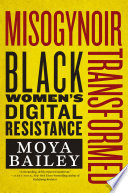
Misogynoir Transformed
by Moya Bailey
- language and languages
- african american women in social media
- social media
- misogyny
- african american women
- social conditions
Keep track of it on your own bookshelf.
Log in to add itAbout this book
Where racism and sexism meet—an understanding of anti-Black misogyny
When Moya Bailey first coined the term misogynoir, she defined it as the ways anti-Black and misogynistic representation shape broader ideas about Black women, particularly in visual culture and digital spaces. She had no idea that the term would go viral, touching a cultural nerve and quickly entering into the lexicon. Misogynoir now has its own Wikipedia page and hashtag, and has been featured on Comedy Central’s The Daily Show and CNN’s Cuomo Prime Time. In Misogynoir Transformed, Bailey delves into her groundbreaking concept, highlighting Black women’s digital resistance to anti-Black misogyny on YouTube, Facebook, Tumblr, and other platforms.
At a time when Black women are depicted as more ugly, deficient, hypersexual, and unhealthy than their non-Black counterparts, Bailey explores how Black women have bravely used social-media platforms to confront misogynoir in a number of courageous—and, most importantly, effective—ways. Focusing on queer and trans Black women, she shows us the importance of carving out digital spaces, where communities are built around queer Black webshows and hashtags like #GirlsLikeUs.
Bailey shows how Black women actively reimagine the world by engaging in powerful forms of digital resistance at a time when anti-Black misogyny is thriving on social media. A groundbreaking work, Misogynoir Transformed highlights Black women’s remarkable efforts to disrupt mainstream narratives, subvert negative stereotypes, and reclaim their lives.
Quotes
From WikiquoteCan a person achieve the WHO definition of health if they encounter racism, sexism, ableism, and other oppressions as a part of their daily life in the world?
The stress and material consequences of system oppression make it nearly impossible to have physical, mental, and social well-being in a white supremacist patriarchal country.
The poem “Brother” by Pat Parker addresses the violence Black women face in their own communities while trying to address systemic oppression: Brother I don’t want to hear about how my real enemy is the system. i’m no genius, but i do know that system you hit me with is called a fist.
More by Moya Bailey
All books
Similar books
by subject-
Women, Race & ClassAngela Y. DavisWomen, Race & ClassAngela Y. Davis

-
As Long as Grass GrowsDina Gilio-WhitakerAs Long as Grass GrowsDina Gilio-Whitaker
-
For Colored Girls who Have Considered Suicide/When the Rainbow is EnufNtozake ShangeFor Colored Girls who Have Considered Suicide/When the Rainbow is EnufNtozake Shange
-
Where We Standbell hooksWhere We Standbell hooks

-
From #BlackLivesMatter to Black LiberationKeeanga-Yamahtta TaylorFrom #BlackLivesMatter to Black LiberationKeeanga-Yamahtta Taylor

-
Invisible ManRalph EllisonInvisible ManRalph Ellison